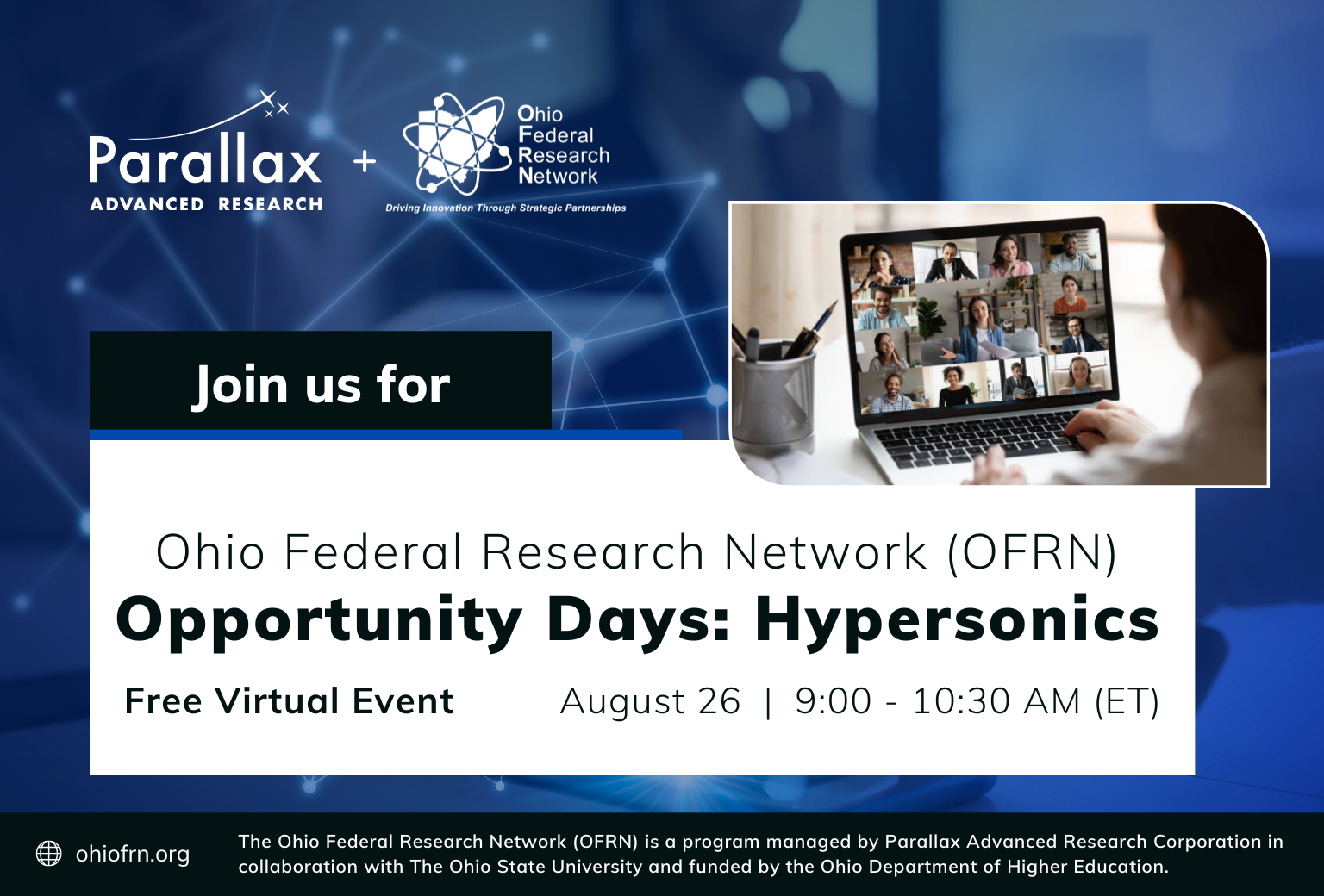
On August 26, 2026, the Ohio Federal Research Network (OFRN) held a virtual Opportunity Day focused on hypersonic flight, advanced manufacturing, and related federal research opportunities. The event brought together representatives from NASA Glenn Research Center, the National Center for Defense Manufacturing and Machining (NCDMM), OnRamp Hub: Ohio, and Parallax Advanced Research.
Presentations examined NASA’s High-Speed Flight project, the Hypersonic Adaptive Manufacturing Incubator in Mentor, Ohio, and active federal opportunities related to hypersonic systems, sensing, structural materials, manufacturing, and technology transition.
The event was designed to help Ohio researchers, companies, and academic institutions better understand federal priorities, identify potential collaborators, and connect their capabilities with current research and commercialization opportunities.
Agenda
- OFRN Overview — Maj. Gen. (Ret.) Mark Bartman, USAF, Executive Director – OFRN, Parallax Advanced Research
- NASA High-Speed Flight Project — Lois J. Weir, senior technologist for hypersonic propulsion, NASA Glenn Research Center
- Hypersonic Adaptive Manufacturing Incubator — Georgette Nelson, Senior Program Manager, National Center for Defense Manufacturing and Machining (NCDMM)
- Opportunity Review — Ryan Blackburn, Ecosystem Engagement Lead - OnRamp Hub: Ohio, Parallax Advanced Research
- Wrap-Up
Watch the complete webinar here:
OFRN Overview
(Download the PowerPoint slides here)

Mark Bartman opened the event with an overview of OFRN’s role in connecting Ohio’s research community with the priorities of federal partners. The network brings together federal agencies, universities, industry organizations, and the State of Ohio to evaluate research needs, form teams, and advance competitive research and development projects.
Through June 30, 2026, OFRN reported the following results across funding Rounds 1–7:
- $72 million in State of Ohio investment
- More than $435 million in follow-on funding awarded
- $42 million in cost share
- 427 jobs
- 17 spinout companies
- 48 funded research and development projects
- 12 intellectual property assets created, with two additional assets pending
- Participation from five government agencies, 116 companies, and 25 academic institutions
OFRN’s Student Experiential Engagement initiative has also involved 228 students across Rounds 5–7, including 42 doctoral students, 50 master’s students, and 136 undergraduate students. These results demonstrate the network’s combined focus on research impact, technology transition, workforce development, and sustained collaboration among government, industry, and academia.
NASA High-Speed Flight Project
(Download the PowerPoint slides here)

Lois J. Weir presented NASA’s High-Speed Flight project, which brings together work in commercial supersonic and hypersonic technology within NASA’s Advanced Air Vehicles Program.
The project is intended to advance technologies that enable high-speed commercial and governmental flight from Mach 1 to Mach 5 and above. Its work includes support for X-59 quiet supersonic aircraft testing, fundamental and applied hypersonic research, and continued use of NASA’s specialized facilities and technical expertise.
NASA’s High-Speed Flight research is organized around several technical areas:
- Systems design, analysis, and validation
- Propulsion technologies
- Reusable high-temperature materials and structural technologies
- Civil transport technologies
- Civil supersonic overland flight technologies
Within propulsion, research topics include enhanced injection and mixing, computational fluid dynamics, advanced pressure sensors, isolator dynamics, high-Mach turbine-engine technologies, ground-test databases, and dynamic propulsion controls.
Materials and structures research addresses high-temperature seals and sensing, ceramic matrix composites, advanced alloys, ground-test techniques, and multidisciplinary support. These technologies are needed to improve the durability and reusability of vehicles operating in demanding high-speed environments.
Weir also emphasized the role of partnerships and academic outreach in developing the future hypersonics workforce. NASA participates in internship, fellowship, postdoctoral, faculty, and university research programs intended to engage students and researchers while advancing nationally relevant technical capabilities.
The broader purpose of the High-Speed Flight project is to enable routine, reusable, airbreathing high-speed flight. Achieving that goal will require coordinated research, technical maturation, infrastructure, workforce development, and technology transfer across government, academia, and industry.
Hypersonic Adaptive Manufacturing Incubator
(Download the PowerPoint slides here)

Georgette Nelson presented NCDMM’s Hypersonic Adaptive Manufacturing Incubator, a facility and collaborative development environment in Mentor, Ohio.
NCDMM works with government, industry, and academic partners to address advanced manufacturing challenges across hypersonics, maritime systems, missiles and unmanned aircraft, and the organic industrial base. Its network includes more than 250 alliance partners and more than 300 America Makes members.
The incubator responds to several barriers that can slow hypersonic technology development, including limited national testing capacity, lengthy qualification processes, fragmented development environments, and the difficulty of transitioning new materials and manufacturing processes into operational systems.
The initiative is establishing a streamlined pathway to design, build, test, and transition hypersonic components while measuring both technology readiness and manufacturing readiness. Its planned capabilities include:
- An integrated hypersonic prototyping and collaboration facility of more than 18,000 square feet
- Installation, testing, demonstration, and evaluation of adaptive manufacturing technologies
- Applied research involving critical hypersonic materials and components
- Ground- and flight-testing support
- Collaboration among government, industry, and academic organizations
- Component-level demonstrations conducted within a common development framework
Material and process areas highlighted during the presentation included carbon-carbon materials, ceramic matrix composites, polymer infiltration and pyrolysis, and other technologies suited to high-temperature applications.
The incubator is also connected to a wider advanced manufacturing portfolio spanning additive manufacturing, robotics and automation, digital engineering, advanced machining, coatings, metrology, artificial intelligence, data analytics, cybersecurity, advanced materials, and augmented and virtual reality.
NCDMM also highlighted the America Makes Technical Review and Exchange, scheduled for October 27–29, 2026, in Los Angeles. Attendance requires an active DD Form 2345. Additional information is available through the America Makes event page.
Opportunity Review
(Download the PowerPoint slides here)

Ryan Blackburn concluded the technical program with a review of federal opportunities relevant to organizations working in hypersonics, sensing, materials, manufacturing, and technology transition.
Opportunities presented during the event included:
- System for Flight Control of Extremely Fast (Hypersonic) Aircraft — A NASA technology-transfer opportunity for U.S. companies interested in licensing a magnetohydrodynamics-based flight-control technology. The opportunity is open through August 10, 2027.
- Hypersonic Infrared Target Sensing – Transition Opportunity — A sources-sought notice seeking U.S. partners for cooperative research and development partnerships to mature infrared sensing technologies and establish transition pathways. Responses are due September 30, 2026.
- Manufacturing Research and Technology Development Open Period — An Air Force opportunity seeking white papers and proposals for advanced manufacturing research. The open period extends through June 22, 2031.
- AFRL Enterprise Commercial Solutions Opening — An indefinite opening for commercial technologies, services, studies, demonstrations, and prototype efforts across the Air Force Research Laboratory mission space.
- Golden Dome for America Commercial Solutions Opening — A long-duration opening seeking technologies, prototypes, and support services addressing homeland-defense mission needs. The opportunity is open through April 1, 2031.
- Navy BAA Call N0001426SBC05 — An opportunity focused on maturing and demonstrating subsystems, materials, design tools, and test articles for hypersonic vehicle development. The call is open through September 30, 2026.
- AFRL Structural Materials Open BAA — A research opportunity covering advanced materials, modeling, characterization, and structural solutions for extreme environments. The announcement remains open through September 2027.
Organizations seeking additional opportunities can consult SAM.gov, Grants.gov, SBIR.gov, the Defense SBIR/STTR program, NASA SBIR/STTR program, ohiofrn.org and apex-innovates.org
Looking Ahead
The August Opportunity Day demonstrated how hypersonic technology development depends on more than vehicle design alone. Progress requires coordinated advances in propulsion, sensing, high-temperature materials, manufacturing, testing, workforce development, and technology transition.
Ohio’s combination of federal research organizations, universities, advanced manufacturers, and collaborative facilities positions the state to contribute across these technical areas. OFRN supports that community by identifying federal research needs, helping organizations find partners, and assisting teams pursuing competitive funding opportunities.
To learn more about upcoming events, research opportunities, matchmaking, or proposal-development support, visit the ohiofrn.org.