

Two undergraduate students spent this summer examining a difficult question: Could information available at the scene of a vehicle crash help emergency responders anticipate injuries before they reach a patient?
Working with Mined XAI’s REACT-X project, Nick Woolard and Henry (Hoan) Nguyen analyzed large crash datasets, explored relationships among crash conditions, locations and injury outcomes, and investigated how artificial intelligence could make complex findings more accessible to emergency personnel.
Their work contributed to REACT-X, short for Resilient Explainable AI for Casualty Triage with Logistics Awareness Using Deep Topological Modeling. The Ohio Federal Research Network-funded project is developing an explainable AI platform to support medical triage, patient care and resource decisions in demanding environments.
Although REACT-X is designed with military medicine in mind, the students’ research explored a civilian application with similar challenges: responding to vehicle crashes when time is limited and critical information remains unknown.
Finding patterns in crash injuries
Caption: Nick Woolard, Ohio State University junior
Nick, a rising junior studying biomedical engineering at The Ohio State University, focused on identifying relationships between crash characteristics and the types of injuries occupants sustained.
First responders may know whether vehicles collided head-on, crossed a centerline, or struck a fixed object, but the type and severity of the occupant injuries may not be immediately apparent. Predicting likely injury patterns from available crash information can provide valuable early insights to support decisions regarding emergency transportation, treatment and the personnel or equipment to be dispatched to the scene.
Nick used federal crash and injury data to build a workflow for identifying recurring injury patterns. Rather than examining injuries individually, the approach grouped injuries that frequently appeared together, helping reveal broader patterns of multisystem trauma.
The analysis identified several notable associations. Centerline-crossing, head-on crashes related to a combination of soft-tissue, cervical spine, chest, abdominal and upper-extremity injuries. High-energy crashes involving fixed objects showed a recurring pattern of upper-body trauma, while several lower-speed angular crash types shared a pattern of abrasions, contusions and lacerations across multiple body regions.
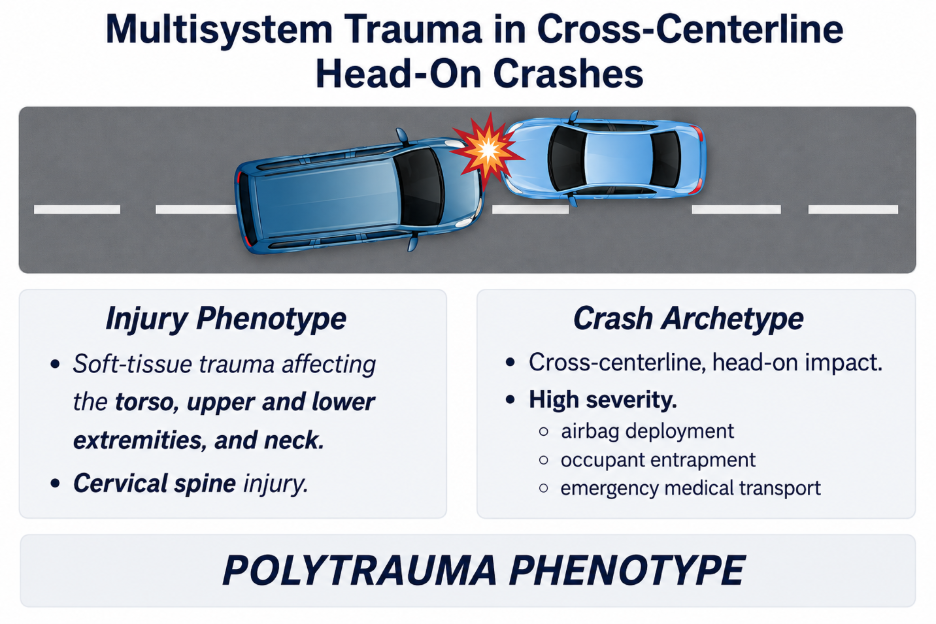
Some findings were consistent with previous crash-injury research, while others provided a more detailed pattern of injury combinations that have received limited attention in existing studies.
“The head-on results showed that several previously discovered injuries that happen in head-on crashes can merge together as a system,” Nick said.
That distinction is important. Knowing that a particular injury can result from a crash is useful, but identifying the combination of injuries would give responders a more complete picture of what they may encounter.
Nick said the relationships identified through the analysis could eventually support emergency response and patient transportation decisions.
Adding location to the picture

Caption: Henry (Hoan) Nguyen, Kenyon College junior
Henry, a rising junior at Kenyon College where he is earning a B.A. in Mathematics and Statistics, approached the question from another direction, studying how crash behavior and geography could be analyzed together.
Using approximately 2.5 million crash records, he developed separate models for crash characteristics and crash locations. Keeping the two components independent allowed each model to learn a different part of the problem: one could identify what kinds of crashes are likely, while the other could determine where crashes tend to occur, without patterns in one category distorting the other. That separation also made it possible to examine and evaluate each source of information on its own before combining them.
The crash-behavior model considered details such as collision type, weather, and lighting conditions, while the location model used geographic information to identify areas where crashes clustered. Henry then used Mined XAI’s data-fusion technologies to test ways of combining the two models and balancing their contributions. The resulting model could draw on both kinds of information, capturing patterns in crash behavior as well as geographic risk, while preserving the insights each model had learned independently.
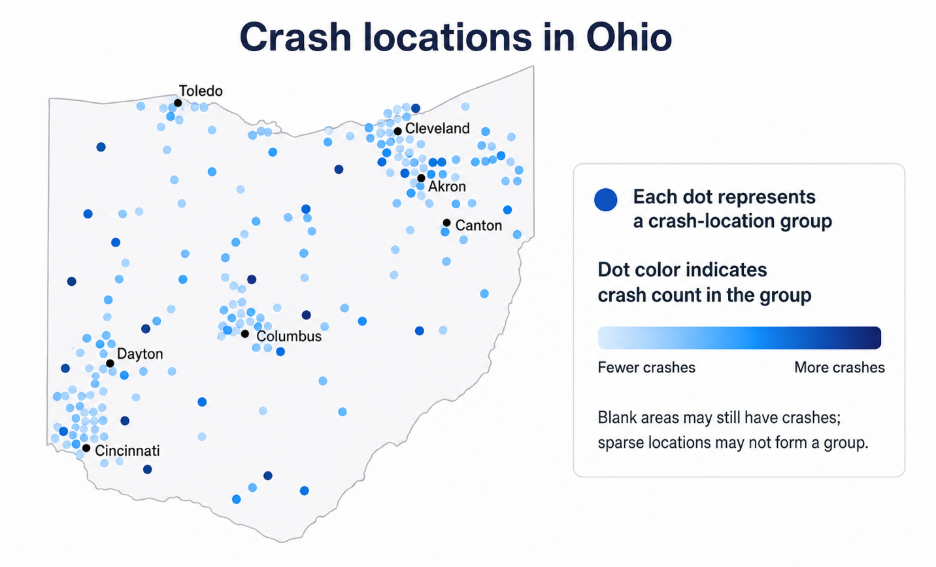
“I developed two models: a crash behavior model and a crash location model. I wanted to understand the relationship between those two types of information,” said Henry.
The analysis showed that certain crash types were strongly associated with specific geographical areas, including patterns around urban centers, while others were more broadly distributed across the state. The findings demonstrated that location can provide additional contextual insight without defining every crash that occurs in a given area.
Henry also explored how a large language model (LLM) could be integrated with his models to make crash and injury information more accessible through natural language. He developed a prototype interface that enables non-technical user to interact with the model and generate outputs of the key factors associated with specific injury outcomes. The longer-term goal would be to create a domain-specific language model grounded in crash and injury phenotypes that can translated complex model outputs into a more understandable format.
Learning through real-world research
The internship gave both students experience working with large, complicated datasets that do not always align neatly. They had to reconcile differences among data sources, test modeling approaches and revise their work in response to feedback.
Nick entered the program with limited experience in Python and data science. By the end of the summer, he had used both to analyze real-world medical and transportation data.
“This was my first internship experience,” he said. “It taught me a lot.”
He also learned how to receive constructive criticism and use it to strengthen his work — a lesson he described as an important part of his professional growth.
Henry said the experience helped him progress from learning the fundamentals of the modeling approach to conducting a complex analysis of his own. It also made him more comfortable working through unfamiliar technical problems, both independently and with support from his mentors.
“By the end of the summer internship, I was more comfortable figuring things out on my own while also knowing when to seek help from my mentors,” said Henry.
Together, the students’ projects illustrate how experiential research can advance a larger technical effort while helping emerging researchers build practical skills. Their findings established early connections among crash circumstances, geography and probable injury patterns — information that could eventually help responders arrive better prepared.
For REACT-X, the work represents another step toward a decision-support platform that does more than generate predictions. It seeks to explain the patterns behind them, translate complex data into useful guidance and help medical personnel make faster, better-informed decisions when lives and resources are at stake.
###
About Ohio Federal Research Network (OFRN)
OFRN has the mission to stimulate Ohio’s innovation economy by building statewide university-industry research collaborations that meet the requirements of Ohio’s federal laboratories, resulting in the creation of technologies that drive job growth for the State of Ohio. The OFRN is a program managed by Parallax Advanced Research in collaboration with The Ohio State University and is funded by the Ohio Department of Higher Education.
About Parallax Advanced Research and the Ohio Aerospace Institute (OAI)
Parallax Advanced Research is a research institute that tackles global challenges through strategic partnerships with government, industry, and academia. It accelerates innovation, addresses critical global issues, and develops groundbreaking ideas with its partners. With offices in Ohio and Virginia, Parallax aims to deliver new solutions and speed them to market. In 2023, Parallax and the Ohio Aerospace Institute (OAI) formed a collaborative affiliation to drive innovation and technological advancements in Ohio and for the nation. The Ohio Aerospace Institute plays a pivotal role in advancing the aerospace industry in Ohio and the nation by fostering collaborations between universities, aerospace industries, and government organizations, and managing aerospace research, education, and workforce development projects.