
DAYTON, Ohio — A Dayton-based technology company is leading a multidisciplinary effort to transform how medics make life-or-death decisions in combat and other high-risk environments.
Mined XAI’s REACT-X — Resilient Explainable AI for Casualty Triage with Logistics Awareness Using Deep Topological Modeling — is designed to improve battlefield medical triage by combining predictive artificial intelligence with real-time logistics insight. The project is part of the Ohio Federal Research Network’s Round 7 portfolio and runs from October 2025 through April 2027.
The system aims to help medics operating in resource-constrained, contested environments determine which patients are most at risk of rapid deterioration, what interventions are required and how limited supplies should be allocated.
“We want to augment human judgment, not replace it,” said Dr. Rajesh Naik, chief operating officer at Mined XAI and a former Air Force civilian familiar with combat casualty care needs. “In a battlefield scenario, the person providing care at the point of injury has to make very quick decisions with incomplete information, often under fire.”
Modern military operations frequently unfold across geographically dispersed terrain where evacuation may be delayed and supplies limited. In those conditions, medics may face multiple casualties while managing shortages of blood products, airway supplies and other critical resources.
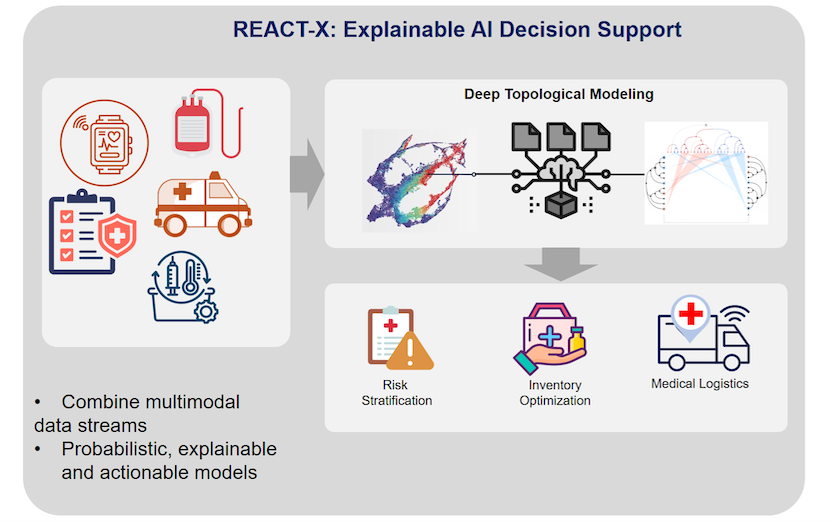
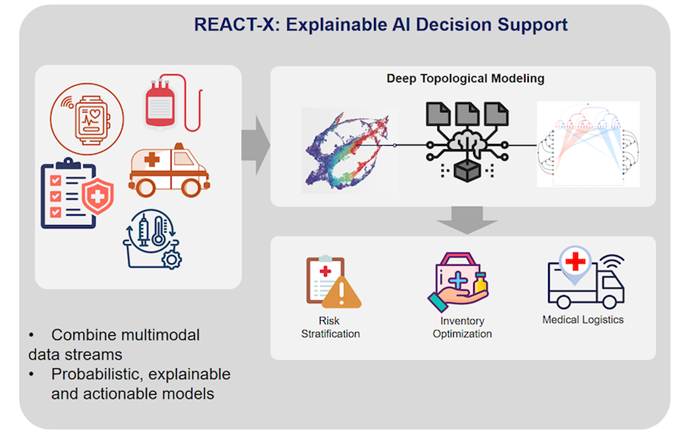
REACT-X addresses that challenge by integrating multimodal data — including physiologic signals, injury information and supply utilization records — into a decision-support platform powered by deep topological modeling. The goal is to identify patterns that signal when a patient is likely to decompensate and what resources will be needed to sustain care.
Dr. Christopher Dean, chief technology officer at Mined XAI, said the system is built around “explainable AI” rather than traditional “black box” models.
In conventional AI systems, users input data and receive a prediction without insight into how the model reached its conclusion. That opacity can undermine trust in high-stakes settings such as medicine or military operations.
“With explainable AI, there’s human-interpretable structure built directly into the model,” Dean said. “When you get a prediction out, you can understand how it was generated. Responders need to know not just what the system predicts, but why.”
Trust and transparency are essential in medical environments, Naik added, where clinicians must have confidence that AI recommendations support — rather than override — professional judgment.
A distinguishing feature of REACT-X is its integration of triage decisions with medical logistics. Instead of assessing patients in isolation, the platform considers available supplies and anticipated depletion rates. That allows commanders and medical teams to align interventions with resource constraints.
“If you’re going to dispatch an ambulance, you want to make sure it’s equipped with the supplies most likely to be needed,” Naik said. “In a battle-space scenario, you may have to care for individuals with what you have on hand. Optimizing the logistics footprint is critical.”
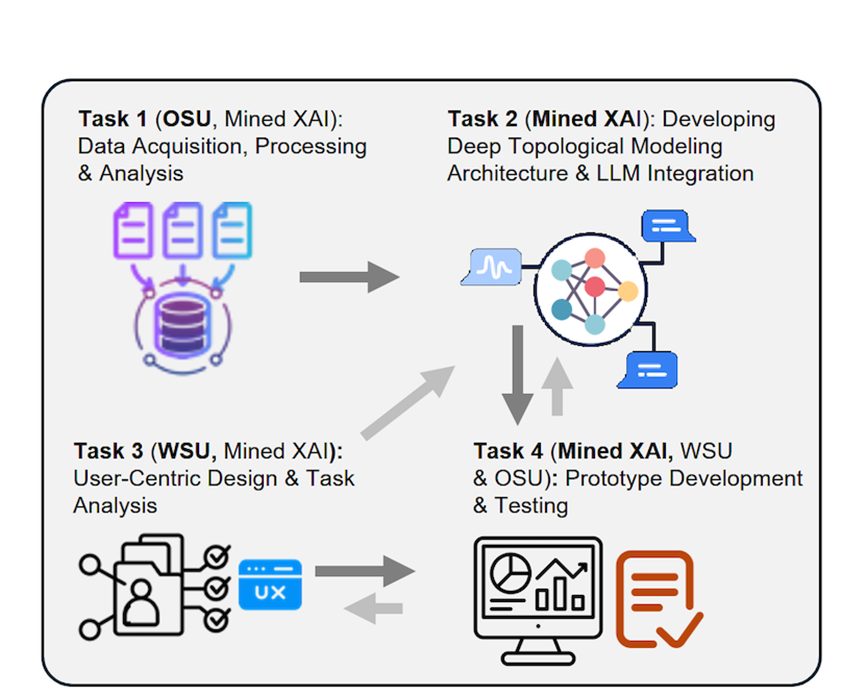
The team is developing role-specific outputs tailored to different users. A frontline medic might see projected injury severity and recommended interventions, while an operations coordinator could receive guidance on resource deployment and resupply priorities.
Although the project’s primary focus is military survivability and readiness, its architecture supports dual-use applications. Because of the sensitive nature of military data, the team is currently using surrogate datasets — such as car crash data — to model injury severity and logistics needs.
In a civilian context, REACT-X could enhance 911 dispatch, emergency medical services routing and trauma center selection by combining vehicle telemetry, witness reports and on-scene assessments to predict injury severity and required interventions.
The system may also prove valuable in prolonged casualty care scenarios, rural emergency response, disaster relief operations and hospital emergency departments experiencing patient surges. By identifying which patients require immediate attention and which can safely wait, providers could improve outcomes while reducing cognitive burden during high-tempo operations.
Ultimately, the developers see REACT-X as a tool to increase survival rates by enabling earlier intervention, smarter resource allocation and more resilient decision-making under uncertainty.
“Humans reason under uncertainty all the time,” Dean said. “Our goal is to build AI systems that can do the same — and make that reasoning transparent and actionable.”
###
About Ohio Federal Research Network (OFRN)
The Ohio Federal Research Network (OFRN) has the mission to stimulate Ohio’s innovation economy by building statewide university-industry research collaborations that meet the requirements of Ohio’s federal laboratories, resulting in the creation of technologies that drive job growth for the State of Ohio. The OFRN is a program managed by Parallax Advanced Research in collaboration with The Ohio State University and is funded by the Ohio Department of Higher Education.
About Parallax Advanced Research and the Ohio Aerospace Institute (OAI)
Parallax Advanced Research is a research institute that tackles global challenges through strategic partnerships with government, industry, and academia. It accelerates innovation, addresses critical global issues, and develops groundbreaking ideas with its partners. With offices in Ohio and Virginia, Parallax aims to deliver new solutions and speed them to market. In 2023, Parallax and the Ohio Aerospace Institute (OAI) formed a collaborative affiliation to drive innovation and technological advancements in Ohio and for the nation. The Ohio Aerospace Institute plays a pivotal role in advancing the aerospace industry in Ohio and the nation by fostering collaborations between universities, aerospace industries, and government organizations, and managing aerospace research, education, and workforce development projects.