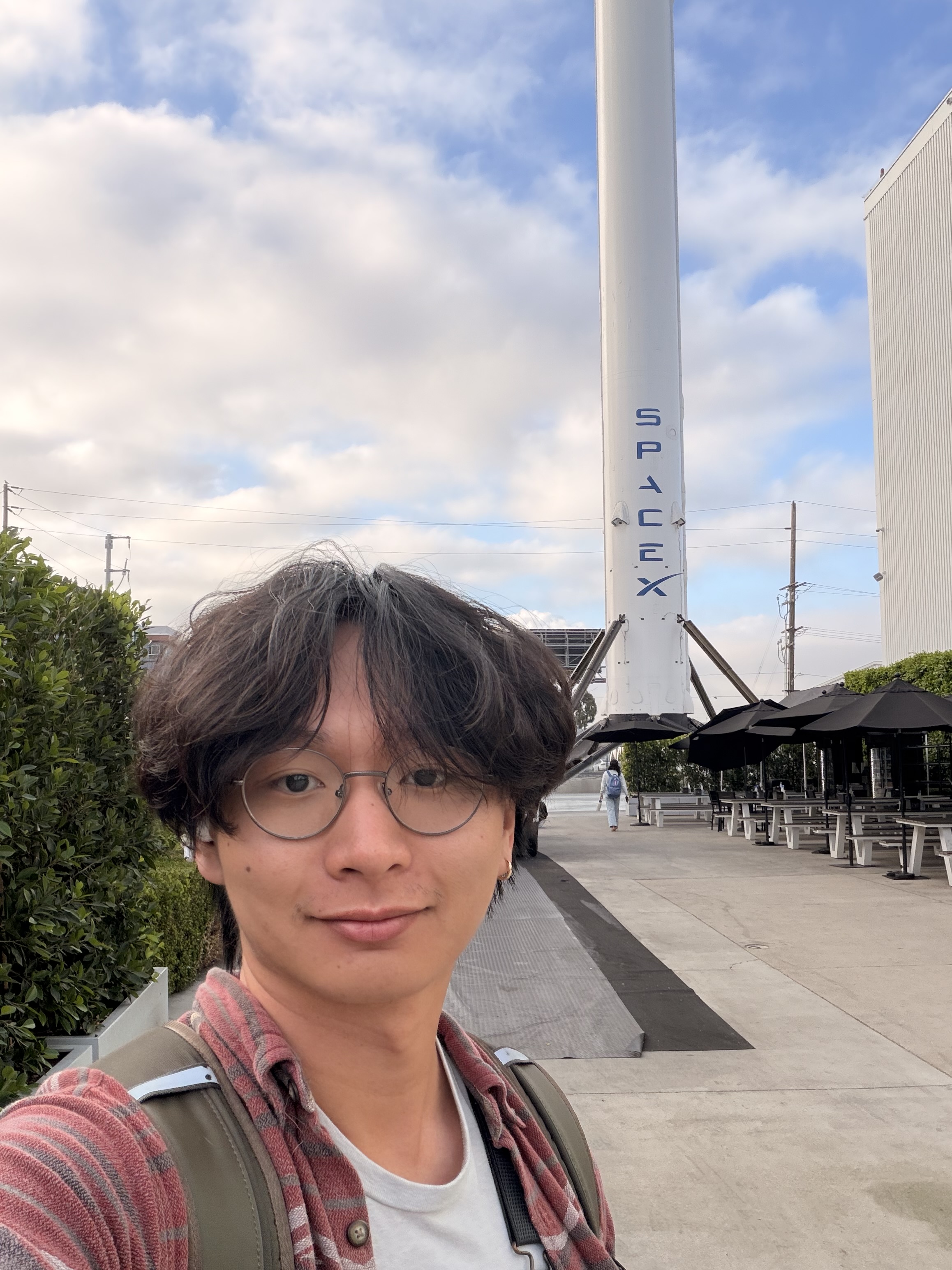
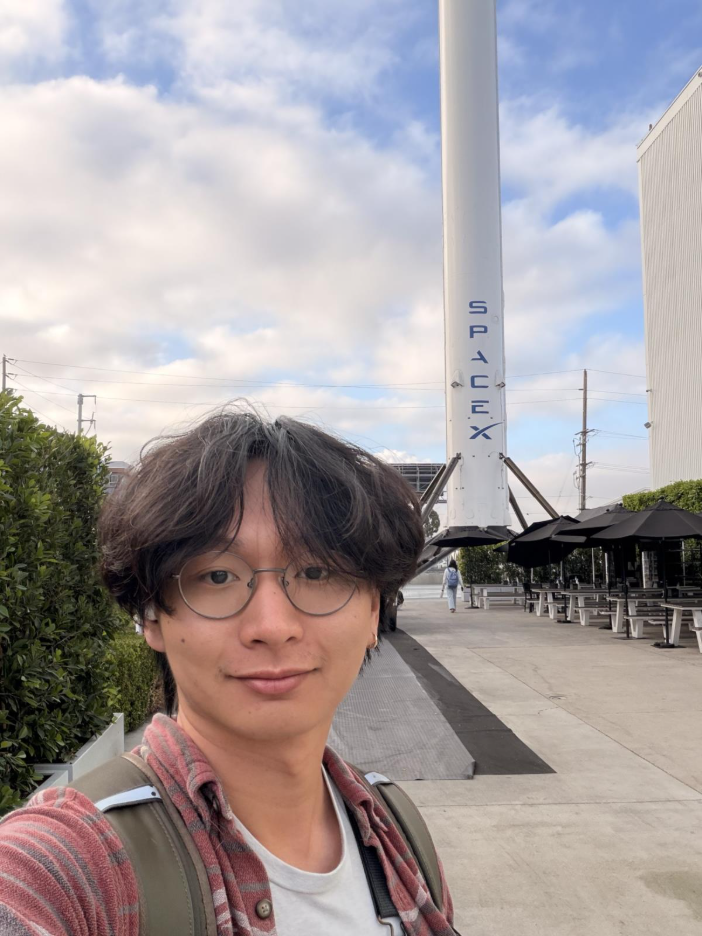
Caption: Choi at SpaceX in Los Angeles, CA
When Eugene Choi first began researching laser welding in space, he was an undergraduate student at The Ohio State University, working on what started as a capstone project. Today, he is a welding engineer at SpaceX, helping manufacture rocket engines designed to travel to the moon and beyond.
Choi credits the Ohio Federal Research Network with helping make that trajectory possible.
“I definitely couldn’t have been working for SpaceX if I didn’t work on this research,” Choi said, referring to The Structural Materials Joining in Space project, that was led by a team at The Ohio State University with support from the Air Force Research Laboratory (AFRL), NASA, and funding from the Ohio Federal Research Network (OFRN).
This project, aimed at advancing laser welding techniques in microgravity, vacuum, and extreme temperatures, holds the potential to transform the way we construct and maintain future space infrastructure — from repairing spacecraft to building lunar habitats.
From Capstone to Cutting-Edge
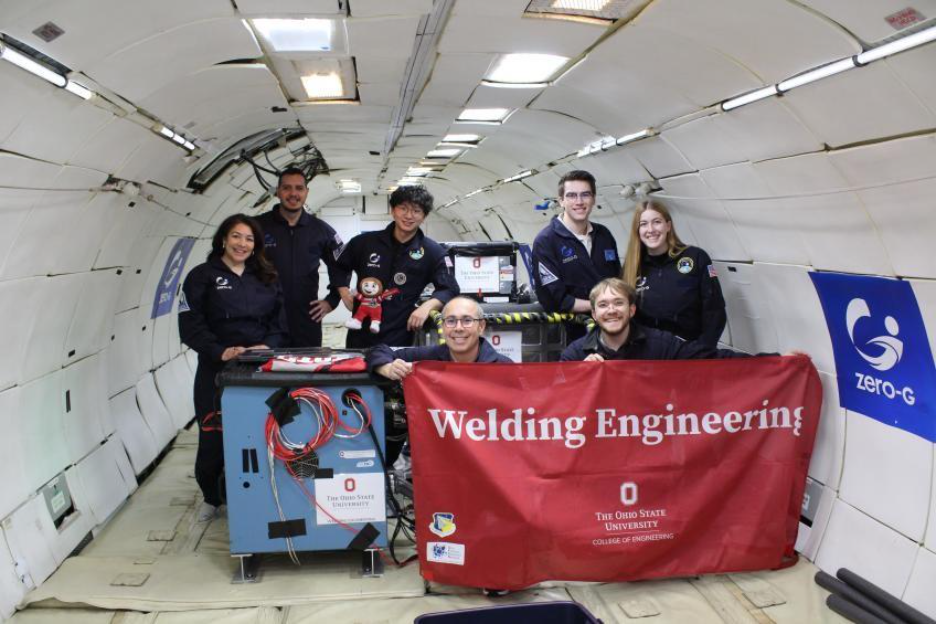
Choi’s work focused on the feasibility of laser welding in a space environment — exploring how the physics of the process changes in microgravity and vacuum compared to atmospheric conditions on Earth.
Answering those questions required more than classroom theory. Simulating space conditions meant parabolic flights and complex experimental setups — efforts that required significant funding and sustained research support.
“Without the help, there’s no way we could have even looked into it,” he said of OFRN’s investment.
That support allowed Choi and his team to dig deep into the fundamental physics of laser welding — time and focus he says is rarely possible in industry environments driven by deadlines.
“Having this opportunity and funding to research really allowed me to better understand the subject,” Choi said.
That foundation now helps him push manufacturing processes further at SpaceX, where innovation is the standard.
Seeing the Full Picture
The OFRN project also exposed Choi to something equally important: the complexity of real-world research collaboration.
As a student, he had primarily focused on technical fundamentals. Through OFRN’s cross-sector model — connecting academia, industry and government — he began to see how large-scale research actually moves forward.
“You’ve got to learn how to communicate with others,” Choi said. He described working with safety experts, technicians and specialists across disciplines — learning to navigate expertise beyond his own. “I actually got to see the full picture of how a research project gets done.”
Those communication skills now serve him daily in California, where collaboration is essential in building next-generation rocket engines.
Advancing Space Manufacturing
Choi believes the original research continues to matter.
As global interest grows in manufacturing and assembling systems in space, understanding processes like laser welding in microgravity becomes increasingly important. The project added to the technical foundation others can now build upon.
“In the future, people are looking into how we’re going to manufacture things in space,” he said.
When researchers investigate that question, the early feasibility work supported by OFRN will be part of the record.
At SpaceX, Choi now works at the edge of manufacturing capability. Pushing the limits requires both speed and precision — and a deep understanding of the underlying science.
“Unless I have this kind of research funding or time dedicated to looking into the science behind it, it’s really hard,” he said.
The intellectual foundation he built in Ohio now enables him to identify improvements others might overlook.
Ohio Roots, Space Ambitions
Born and raised in Columbus and a graduate of Dublin Scioto High School, Choi spent his entire life in Ohio before relocating to California.
He moved for one reason.
“I want to make rockets,” he said.
Caption: Choi at SpaceX in Los Angeles, CA
Still, Ohio remains home. Choi says he can envision returning one day to raise a family, calling it “the best place to raise a family.”
For now, he is exactly where he needs to be — contributing to the future of space exploration.
His journey reflects the mission of the Ohio Federal Research Network: investing in research that not only advances technology but also prepares talent to lead in the industries of tomorrow. From a student investigating whether laser welding could work in space to an engineer building engines that leave Earth’s atmosphere, Choi’s path is a testament to what that investment can make possible.
###
About Ohio Federal Research Network (OFRN)
The Ohio Federal Research Network (OFRN) has the mission to stimulate Ohio’s innovation economy by building statewide university-industry research collaborations that meet the requirements of Ohio’s federal laboratories, resulting in the creation of technologies that drive job growth for the State of Ohio. The OFRN is a program managed by Parallax Advanced Research in collaboration with The Ohio State University and is funded by the Ohio Department of Higher Education.
About Parallax Advanced Research and the Ohio Aerospace Institute (OAI)
Parallax Advanced Research is a research institute that tackles global challenges through strategic partnerships with government, industry, and academia. It accelerates innovation, addresses critical global issues, and develops groundbreaking ideas with its partners. With offices in Ohio and Virginia, Parallax aims to deliver new solutions and speed them to market. In 2023, Parallax and the Ohio Aerospace Institute (OAI) formed a collaborative affiliation to drive innovation and technological advancements in Ohio and for the nation. The Ohio Aerospace Institute plays a pivotal role in advancing the aerospace industry in Ohio and the nation by fostering collaborations between universities, aerospace industries, and government organizations, and managing aerospace research, education, and workforce development projects.