
On February 10, 2026, the Ohio Federal Research Network (OFRN) hosted its latest Virtual Opportunity Day, bringing together members of Ohio’s academic, industry, and government innovation ecosystem for a focused discussion on space research, technology development, and federal R&D opportunities.
The event featured thought leader presentations from The Ohio State University, NASA Glenn Research Center, and the Air Force Research Laboratory, alongside an overview of active and emerging funding opportunities relevant to the space domain.
OFRN Opportunity Days are delivered by Parallax Advanced Research, in collaboration with The Ohio State University and the Ohio Department of Higher Education, and are designed to spark new collaborations, inform stakeholders of emerging research priorities, and strengthen Ohio’s competitive position in securing federal R&D funding.
Agenda
- OFRN Overview – Maj. Gen. (Ret.) Mark Bartman, USAF, Executive Director, Ohio Federal Research Network, Parallax Advanced Research
- Research as First Link in Value Chain of Prosperity; Space as the Next Domain for that Research – John Horack, Vice President for Research, Enterprise for Research, Innovation and Knowledge, The Ohio State University
- Lunar Surface Power Needs, Challenges, and Technologies – Jeremiah McNatt, Principal Technologist for Power and Energy Storage, Space Technology Mission Directorate, NASA Glenn Research Center
- AFRL Deputy Technology Executive Office for Space Overview – Chad Waddington, Sensing Autonomy Technical Area Lead, Air Force Research Laboratory
- Opportunity Review
- Wrap-Up and Q&A
Watch the webinar here:
OFRN Overview
The event opened with remarks from Maj. Gen. (Ret.) Mark Bartman, USAF, Executive Director of the Ohio Federal Research Network at Parallax Advanced Research. He provided an overview of OFRN’s mission, collaborative model, and statewide impact, emphasizing how the program connects Ohio’s researchers and innovators with federal agencies to pursue high-value R&D opportunities in critical technology areas—including space.
Download here: OFRN Overview
Research as First Link in Value Chain of Prosperity; Space as the Next Domain for that Research

John M. Horack, PhD
Vice President for Research
Enterprise for Research, Innovation and Knowledge
The Ohio State University
John M. Horack is the vice president for research at The Ohio State University where he leads the Enterprise for Research, Innovation and Knowledge (ERIK), overseeing strategic research operations, commercialization initiatives, and collaborative partnerships across the university. A 30-year veteran of the spaceflight industry, he is a globally recognized leader in space-based research, flight hardware development, program management, and space policy in the academic, government and private sectors. His appointment aligns with Ohio State’s ambitious Education for Citizenship 2035 strategic plan, which aims to grow the university’s research enterprise to $2 billion by 2035.
Dr. Horack is the inaugural holder of the Neil Armstrong Chair in Aerospace Policy at Ohio State, with tenured, full-professor appointments in the College of Engineering’s Mechanical and Aerospace Engineering department and the John Glenn College of Public Affairs. Prior to joining Ohio State in 2016, he served for four years as vice president of Teledyne Brown Engineering’s Space Systems group in Huntsville, Alabama, with responsibility for overseeing all government and commercial Space programs, including Science, International Space Station Payload Operations, Test Support, Flight Hardware, Launch Vehicle and Component Development, and Earth Imaging, including the deployment of the MUSES commercial imaging platform to the ISS and the installation of state-of-the-art Hyperspectral instrumentation for commercial remote sensing.
From 2009-2012 Dr. Horack served as vice president of research for The University of Alabama in Huntsville, where he had fiscal oversight for the university’s research enterprise, including 14 research centers and laboratories. During his tenure the university grew annual research expenditures from $65M to nearly $100 million and moved from R2 to R1.
Download here: Research as First Link in Value Chain of Prosperity; Space as the Next Domain for that Research
Lunar Surface Power Needs, Challenges, and Technologies

Jeremiah McNatt
Principal Technologist, Power and Energy Storage
NASA Space Technology Mission Directorate
NASA Glenn Research Center
Jeremiah McNatt is the Principal Technologist for Power and Energy Storage for the NASA Space Technology Mission Directorate, residing at NASA Glenn Research Center in Cleveland, Ohio. In this role, he serves as a subject matter expert for power generation, storage, management and distribution and works to define technology gaps and guide investments to meet future NASA mission needs. Prior to this, he spent 21 years developing space solar photovoltaic-related technologies including thin film, organic, and high-efficiency cells along with solar arrays for unique applications including high temperature/high intensity, low temperature/low intensity, and planetary surfaces. He was heavily involved in the technical management of the Roll-Out Solar Array (ROSA) technology which was used on the Double Asteroid Redirection Test (DART) mission and is currently being used on the International Space Station. He earned a bachelor’s degree in physics from The University of Akron and a master’s degree in Materials Science and Engineering from Case Western Reserve University.
Download here: Lunar Surface Power Needs, Challenges, and Technologies
AFRL Deputy Technology Executive Office for Space Overview
Dr. Chad Waddington
Autonomous Sensing and Orchestration Technical Area Lead
Sensors Directorate
Air Force Research Laboratory
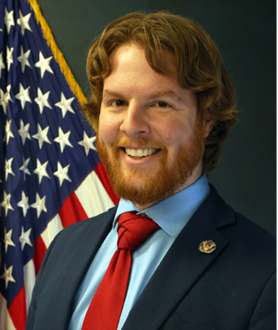
Dr. Chad Waddington was recruited by the Air Force Research Laboratory’s Sensors Directorate while finishing his PhD in Mathematics from Colorado State University. His early work focused on Synthetic Aperture Radar, Passive Source Localization, and Over the Horizon Radar. Over time, his focus shifted to AI and Machine Learning. At the Sensor’s Directorate, Dr. Waddington was one of the co-creators of the AFRL Vanguard program: Skyborg and the AFRL Autonomous Air Combat Operations program. He also served as Junior Force President.
Dr. Waddington became the Special Assistant to the Chief Scientist of the Department of the Air Force at the Pentagon in 2022. There, he led the S&T line of effort for the Secretariat Enterprise Support Functions Working Group which stood up the DAF level offices for the newly created USSF. In 2022, he returned to AFRL and led the Transformational Capabilities Office’s space efforts, later becoming the Assistant Deputy TEO for Space at AFRL HQ, the AFRL NASA Liaison, and lead of the AFRL Autonomy Community of Practice (CoP).
Dr. Waddington has just taken on a new role as the Autonomous Sensing and Orchestration Technical Area Lead. He continues to be heavily involved in AFRL’s space efforts, particularly Space Domain Awareness, and continues to lead the AFRL Autonomy CoP.
Download here: AFRL Deputy Technology Executive Office for Space Overview
Opportunity Review
The Opportunity Review highlighted current and upcoming federal research funding opportunities aligned with space science, space systems, autonomy, power and energy, and related enabling technologies. These opportunities are intended to stimulate new collaborations across Ohio and position teams for competitive proposal development.
Download here: Opportunity Review
Join us for our next quarterly Opportunity Day. Subscribe to the OFRN newsletter for upcoming announcements at https://ohiofrn.org.
###
About Parallax Advanced Research & Ohio Aerospace Institute
Parallax Advanced Research is a research institute that tackles global challenges through strategic partnerships with government, industry, and academia. It accelerates innovation, addresses critical global issues, and develops groundbreaking ideas with its partners. With offices in Ohio and Virginia, Parallax aims to deliver new solutions and speed them to market. In 2023, Parallax and the Ohio Aerospace Institute (OAI) formed a collaborative affiliation to drive innovation and technological advancements in Ohio and for the Nation. OAI plays a pivotal role in advancing the aerospace industry in Ohio and the nation by fostering collaborations between universities, aerospace industries, and government organizations and managing aerospace research, education, and workforce development projects.
About the Ohio Federal Research Network
The Ohio Federal Research Network has the mission to stimulate Ohio’s innovation economy by building statewide university-industry research collaborations that meet the requirements of Ohio’s federal laboratories, resulting in the creation of technologies that drive job growth for the State of Ohio. The OFRN is a program managed by Parallax Advanced Research in collaboration with The Ohio State University and is funded by the Ohio Department of Higher Education.