
Rebecca Gilligan’s path to becoming an Aerospace Engineer at Northrop Grumman began not in a classroom, but in a lab, where hands-on research, real-world testing, and mission-relevant challenges shaped her into an industry-ready engineer.
Gilligan earned her B.S. in Mechanical Engineering and M.S. in Aerospace Engineering from the University of Cincinnati, completing her graduate studies under Dr. Kelly Cohen through UC’s ACCEND program. From the start of her undergraduate career, she immersed herself in applied research, working in the Unmanned Aerial Vehicle (UAV) MASTER Lab and later the AI Bio Lab, where she would spend years developing and testing autonomous systems.
During Gilligan’s time in the UAV MASTER Lab and later the AI Bio Lab, several Ohio Federal Research Network (OFRN)-funded research efforts were underway, embedding her day-to-day work in a mission-aligned environment focused on autonomy, safety, and operational relevance. Although she was supported through OSGC, working alongside OFRN projects exposed her to the same real-world constraints, like flight safety, verification, and deployability, that shape federal aerospace programs.
“I attended UC for my B.S. in Mechanical Engineering and worked with the UAV MASTER Lab and later the AI Bio Lab,” Gilligan said. “That research and lab experience shaped everything that came after.”
Discovering Autonomy Through Research
Gilligan’s interest in unmanned systems can be traced back to her high school experience with the FIRST Robotics Competition, where she first fell in love with robotics and systems engineering. UAVs became a natural next step.
“Wanting to continue working in robotics, UAVs and unmanned systems seemed like a good path,” she said.
As an Ohio Space Grant Consortium Undergraduate Scholar and Graduate Fellow, Gilligan tackled complex research problems at the intersection of autonomy, safety, and control. Her work spanned UAV–UGV teaming, expanding mission capabilities through a leveling platform, and later advanced into precision landing for multirotor aircraft—a technically demanding and operationally relevant challenge.
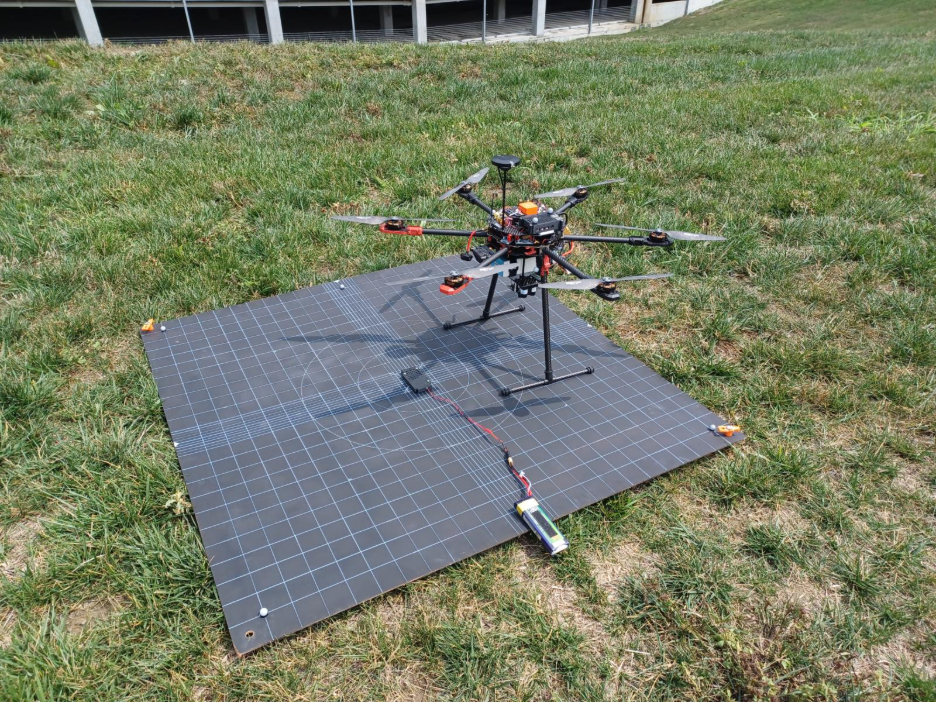
Her master’s thesis, “Safety Assurance and Risk Estimation for Multi-Rotor Precision Landing,” focused on integrating a fuzzy-logic–based risk assessment algorithm directly into the landing control loop, improving decision-making during high-risk phases of flight.

Caption: Drone precision landing.
“Rebecca consistently approached research with an engineer’s mindset—focused on validation, robustness, and real-world performance,” said Dr. Kelly Cohen, Brian H. Rowe Endowed Chair in Aerospace Engineering, University of Cincinnati. “Her exposure to OFRN-aligned autonomy research helped prepare her to operate in environments where systems must work reliably outside the lab.”
Applied Research That Builds Engineers
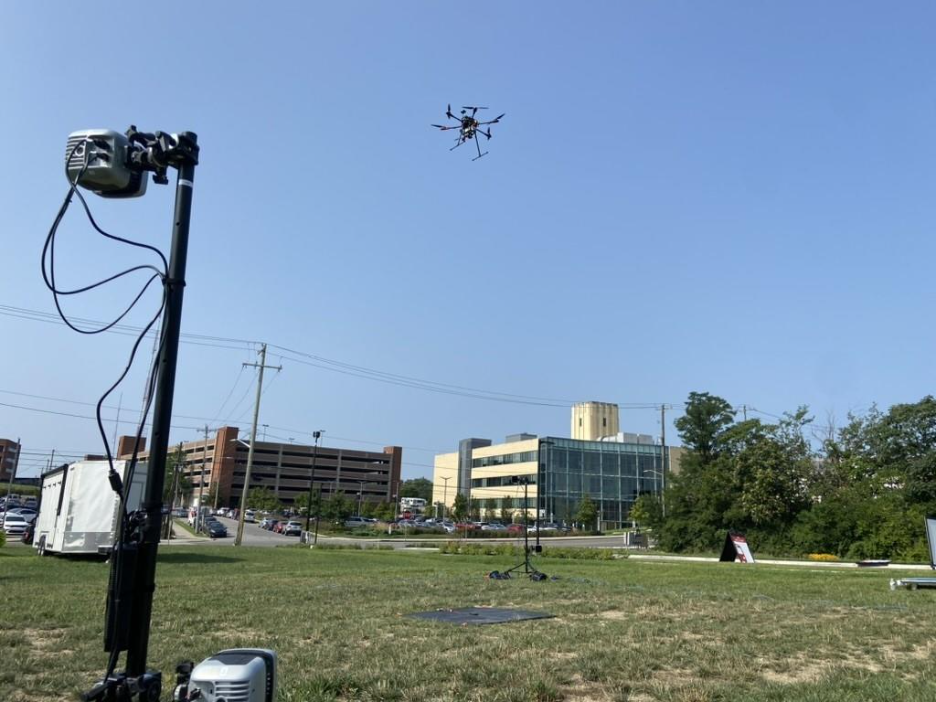
Caption: UAV test with the motion capture.
Training in a lab environment grounded in applied, mission-aligned research proved to be pivotal in preparing Gilligan for industry.
“The flight test and data analysis experience was incredibly valuable,” she said. “A lot of times what you learn in school isn’t really applied, and my research experience eased the transition to industry.”
Unlike purely theoretical work, Gilligan’s research required flight testing, data validation, and iterative refinement—skills she now relies on daily in her role at Northrop Grumman.
“My research taught me far more than my classes,” she said. “It fundamentally changed how I approach engineering problems.”
Recognition, Momentum, and the Power of Opportunity
Gilligan’s work earned consistent national recognition, including:
AIAA Daedalus 88 Undergraduate Scholarship ($10,000)
First Place, AIAA Region III Conference
UC Presidential Leadership Medal
Multiple SRIDE Fellowships at both undergraduate and graduate levels
But for Gilligan, the impact of these awards went beyond accolades.
“Receiving these awards was validating, but more importantly, one small award early in undergrad propelled everything forward,” she said. “Funding and recognition snowballed, and between scholarships, grants, and co-op, I was able to meet my goal of completing school debt free.”
Presenting her work at conferences such as AIAA SciTech also played a key role in building confidence and professional networks.
“Presenting—first regionally, then at SciTech—helped me get comfortable communicating my work and building a network,” Gilligan noted. “That network led directly to some of the opportunities I had later.”
A Workforce Pipeline That Works
Now working in the defense and aerospace industry, Gilligan credits OSGC and the research environments aligned with OFRN priorities, for making her career possible.
“Regardless of where students end up, OSGC is a fantastic program,” she said. “It provides funding to get involved in research and an avenue to present your work. My research was the most valuable part of my academic experience by far—and OSGC was the first award that helped propel everything forward.”
Her story underscores how early investment in students—combined with applied research ecosystems—creates a workforce ready to contribute on day one.
“Rebecca’s experience highlights how OFRN’s impact extends beyond individual project teams,” said Maj. Gen. (Ret.) Mark Bartman, Executive Director, OFRN. “By supporting applied research within shared laboratory environments, OFRN helps shape the training of students like Rebecca, who gain exposure to federally relevant challenges and workflows even when their primary funding comes from the OSGC.”
Advice for the Next Generation
When asked what advice she would give students considering research in UAVs, autonomy, or AI, Gilligan’s answer was simple and emphatic:
“Attend conferences. Present your work. Build a network.”
As she looks ahead, Gilligan remains excited to work on complex, mission-driven aerospace challenges—bringing with her the skills, mindset, and confidence built through years of hands-on research in Ohio.
“Her journey reflects the shared mission of OFRN and OSGC: not just educating students but developing engineers capable of delivering real-world solutions for national defense and aerospace missions,” said Tim Hale, Program Manager, OSGC.
###
About Parallax Advanced Research & Ohio Aerospace Institute
Parallax Advanced Research is a research institute that tackles global challenges through strategic partnerships with government, industry, and academia. It accelerates innovation, addresses critical global issues, and develops groundbreaking ideas with its partners. With offices in Ohio and Virginia, Parallax aims to deliver new solutions and speed them to market. In 2023, Parallax and the Ohio Aerospace Institute (OAI) formed a collaborative affiliation to drive innovation and technological advancements in Ohio and for the Nation. OAI plays a pivotal role in advancing the aerospace industry in Ohio and the nation by fostering collaborations between universities, aerospace industries, and government organizations and managing aerospace research, education, and workforce development projects.
About the Ohio Federal Research Network
The Ohio Federal Research Network has the mission to stimulate Ohio’s innovation economy by building statewide university-industry research collaborations that meet the requirements of Ohio’s federal laboratories, resulting in the creation of technologies that drive job growth for the State of Ohio. The OFRN is a program managed by Parallax Advanced Research in collaboration with The Ohio State University and is funded by the Ohio Department of Higher Education.
About The Ohio Space Grant Consortium
The Ohio Space Grant Consortium (OSGC) was established in 1989 (along with the original Ohio 12-member universities) by the United States Congress and is part of the National Space Grant College and Fellowship Program known as “Space Grant” administered through the Office of STEM Engagement at NASA Headquarters. There are 52 consortia, one in each state, the District of Columbia, and the Commonwealth of Puerto Rico. Space Grant is a unique national network of colleges and universities working to expand opportunities for Americans to understand and participate in NASA’s aeronautics and space projects by supporting and enhancing Science, Technology, Engineering, and Mathematics (STEM) through scholarships, fellowships, higher education, research infrastructure, pre-college (K-12), and informal education public outreach efforts. The Space Grant national network includes over 1,000 affiliates from universities, colleges, industry, museums, science centers, and state and local agencies. The OSGC is currently composed of 26 institutions of higher learning (20 universities and 6 community colleges), NASA Glenn Research Center (GRC), the Air Force Research Laboratories (AFRL), and various education outreach partners. The OSGC Program Office is located at the Ohio Aerospace Institute (OAI) in Cleveland, Ohio.