When Will McAuley first joined an Ohio State University research team exploring laser welding in space, he was simply looking to complete his senior capstone project. Today, that opportunity has transformed the direction of his career — and positioned him to enter the workforce with hands-on experience in one of the most forward-looking areas of space manufacturing.
McAuley began working on the project during the final year of his undergraduate degree in welding engineering, recruited by fellow researcher Eugene Choi. At the time, he expected the experience to conclude with graduation. Instead, it sparked something much bigger.
“I had no plans of doing grad school when I started,” McAuley said. But after working on the project, he decided to stay and pursue a master’s degree so he could continue the research and help push it further.
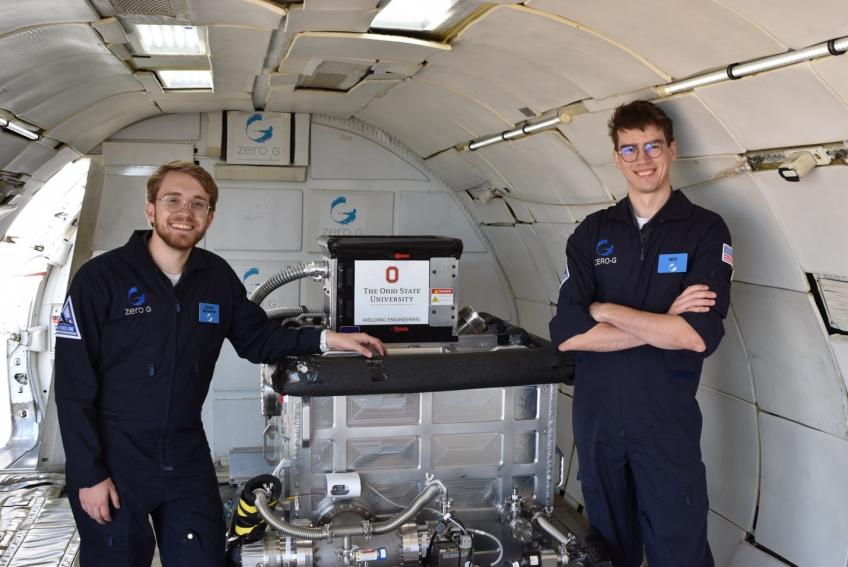
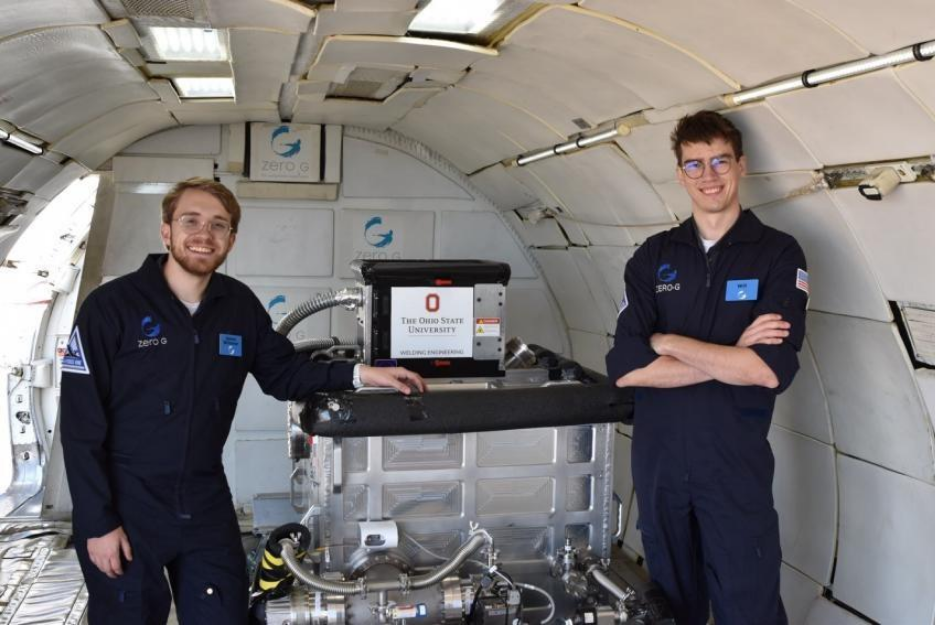 Caption: Ohio State students Aaron Brimmer (left) and Will McAuley (right) setting up the vacuum chamber inside the Zero G Boeing 727. Photo taken in late August 2024 in Santa Maria, CA.
From Classroom Theory to Real-World Research
Through support from the Ohio Federal Research Network, McAuley moved beyond traditional coursework into the hands-on work of building and testing a system designed to study laser welding in microgravity.
In the lab, that meant helping design and construct a specialized vacuum chamber capable of supporting laser welding experiments during parabolic flight — conditions that simulate the weightlessness of space.
The experience dramatically expanded the skills he developed during his degree.
“I’ve gotten so much more experience in the past two years than I really got a lot of in my undergrad,” McAuley said.
Beyond theoretical knowledge, he strengthened technical skills ranging from coding in MATLAB and Python to designing experimental hardware capable of operating in extreme conditions.
But perhaps the most valuable lesson was learning how research unfolds in the real world.
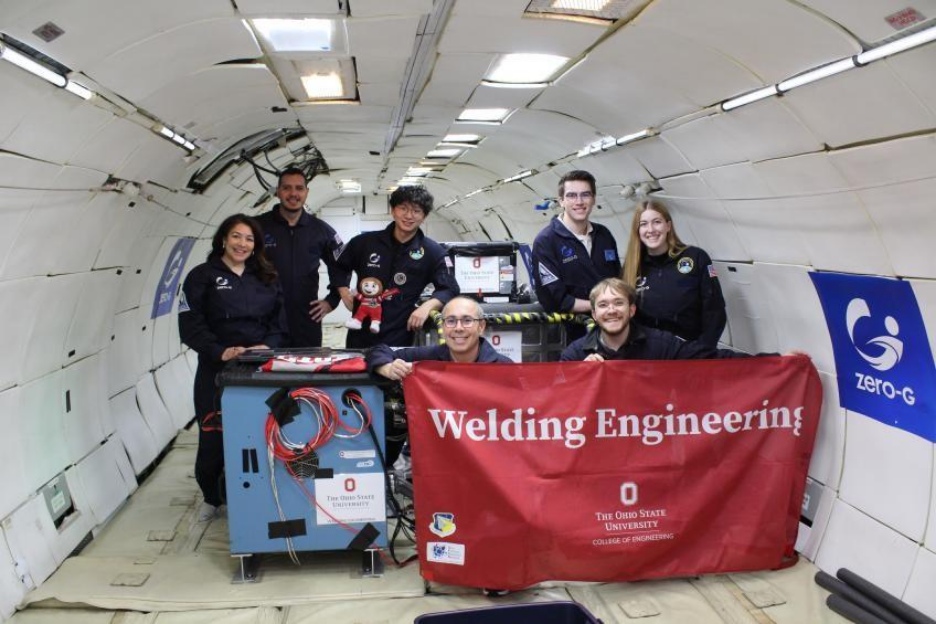 Caption: The Structural Materials Joining in Space project team from The Ohio State University. Photo taken in May 2025 in Salina, KS.
Learning to Adapt
Complex engineering projects rarely follow a perfect plan — something McAuley learned quickly while working on the OFRN-supported effort.
“Half an hour into the day that plan goes out the window because something new popped up,” he said.
The experience forced him to build the adaptability and problem-solving skills required to navigate unexpected technical challenges — abilities he believes will serve him well as he transitions into the professional workforce.
“Being able to adapt and solve problems while balancing a million different things at the same time is really going to help me when I move from college into an actual career,” McAuley said.
A Project That Built Confidence
The space welding research has drawn attention from across the aerospace and manufacturing communities, generating articles, interviews and outside interest in the work being done at Ohio State.
For McAuley, that visibility had an unexpected impact.
Seeing people engage with the research — and recognizing that the work mattered beyond the lab — helped build confidence in his abilities as an engineer.
“It’s kind of been really eye-opening,” he said. “People are interested in the work we’re doing.”
What Comes Next
As he prepares to graduate, McAuley plans to remain in Columbus for the next few years while building his professional foundation.
Longer term, however, he hopes to continue working in the emerging field of space manufacturing — an area he discovered through the OFRN-supported research.
“I’d love to end up somewhere that’s doing similar work,” he said.
That could mean joining the commercial space industry, where companies are rapidly advancing technologies to support future missions. It could also mean contributing to government efforts like NASA’s Artemis program, which aims to return humans to the Moon.
Either way, McAuley believes the experience of working on a project supported by academia, industry and government partners has already given him a head start.
“We’ve worked with all three — academia, industry and government — all at the same time,” he said.
That collaborative environment reflects the mission of the Ohio Federal Research Network: connecting research, talent and industry to strengthen Ohio’s role in the future of advanced technology.
And for McAuley, the journey may not end there. One day, he says, he could even see himself returning to OFRN — this time as a principal investigator seeking support for the next generation of space manufacturing research.
“It would be really neat,” he said.
###
About Ohio Federal Research Network (OFRN)
The Ohio Federal Research Network (OFRN) has the mission to stimulate Ohio’s innovation economy by building statewide university-industry research collaborations that meet the requirements of Ohio’s federal laboratories, resulting in the creation of technologies that drive job growth for the State of Ohio. The OFRN is a program managed by Parallax Advanced Research in collaboration with The Ohio State University and is funded by the Ohio Department of Higher Education.
About Parallax Advanced Research and the Ohio Aerospace Institute (OAI)
Parallax Advanced Research is a research institute that tackles global challenges through strategic partnerships with government, industry, and academia. It accelerates innovation, addresses critical global issues, and develops groundbreaking ideas with its partners. With offices in Ohio and Virginia, Parallax aims to deliver new solutions and speed them to market. In 2023, Parallax and the Ohio Aerospace Institute (OAI) formed a collaborative affiliation to drive innovation and technological advancements in Ohio and for the nation. The Ohio Aerospace Institute plays a pivotal role in advancing the aerospace industry in Ohio and the nation by fostering collaborations between universities, aerospace industries, and government organizations, and managing aerospace research, education, and workforce development projects.