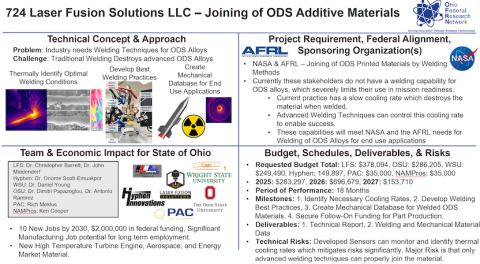
In a lab where cutting-edge materials are being developed for extreme environments, the future of manufacturing isn’t just being built—it’s being learned. Through an Ohio Federal Research Network (OFRN)-funded project “Joining of ODS Additive Materials” led by Laser Fusion Solutions, students aren’t just observing innovation—they’re driving it.
At the center of the work is oxide dispersion strengthened (ODS) material, a next-generation metal designed to withstand extreme heat and stress. As CEO Dr. Chris Barrett explains, the concept is simple—but powerful: imagine a metal infused with tiny oxide particles, like “sprinkles in a confetti cake,” that reinforce the material at high temperatures. That strength makes ODS materials ideal for applications in aerospace and defense—inside jet engines, rocket systems, and other demanding environments where traditional materials fall short.
But the real story isn’t just about the material. It’s about the people learning to build it.
A Project Designed Around Students
Unlike traditional research efforts that prioritize speed, this project was intentionally structured differently.
“We crafted this project so that it was student-run with expert supervision,” Barrett said.
Students are embedded in every stage of the process—from raw material development to final testing—gaining exposure that typically takes years to accumulate in industry.
Meet Isaac: From Business Student to Engineer
For Isaac Groeger, the path into advanced manufacturing wasn’t linear.
“I originally went for business management and found that I liked working with my hands,” Groeger said.
That realization led him to pursue electromechanical engineering—combining technical problem-solving with hands-on work. Now, through the OFRN project, he’s applying those skills in a real-world, high-stakes environment.
His day-to-day work involves reconfiguring advanced manufacturing machines, installing new control systems, integrating software, and enabling real-time data collection to monitor and adjust metal 3D printing processes.
In the classroom, systems are clean, modern, and predictable. In the real world, Isaac found something very different.
“A lot of the machines… are older,” he said. “You have to figure out how to work with what you have.”
That means troubleshooting outdated software, reverse-engineering missing parts, and sometimes redesigning entire systems when components no longer exist.
“There’s a lot of trial and error… and eventually landing on a solution that works,” he said.
When Student Work Drives Real Outcomes
The impact of student contributions isn’t theoretical, it’s immediate. In one instance, a critical machine supporting the project failed. A student—trained through hands-on experience—helped diagnose and repair the issue, getting the system back online in just days. That machine went on to produce key test components for the project. For Barrett, it’s proof that this model works.
“These are students working directly with industry partners who want to hire them after they’re done,” he said. “This is very niche, complex work. You can’t just hire off LinkedIn.”
Instead, the company uses projects like this to identify, mentor, and develop future employees.
Students gain exposure. Companies evaluate fit. And both sides benefit.
Isaac is already seeing that pathway unfold.
“I intend to work at my company full time… It’s exactly the kind of work that I enjoy,” he said.
Why It Matters for Ohio—and Beyond
The implications go beyond a single project. By combining research, workforce development, and industry collaboration, OFRN is helping companies:
Advance new technologies
Explore new markets
And build the skilled workforce needed to sustain both
The ODS project, for example, could expand the use of high-performance materials beyond specialized applications into broader manufacturing—unlocking new commercial opportunities.
At the same time, it’s giving students a direct pathway into those emerging industries.
For students considering similar opportunities, Isaac keeps it simple:
“Try it out, 100%. The first step is the hardest… but it’s worth it.”
In Ohio, innovation isn’t happening in isolation. It’s happening in labs, on shop floors, and in classrooms—where students are not just preparing for the future but actively building it. And through OFRN and companies like Laser Fusion Solutions, that future is arriving faster—and more prepared—than ever before.
###
About Ohio Federal Research Network (OFRN)
The Ohio Federal Research Network (OFRN) has the mission to stimulate Ohio’s innovation economy by building statewide university-industry research collaborations that meet the requirements of Ohio’s federal laboratories, resulting in the creation of technologies that drive job growth for the State of Ohio. The OFRN is a program managed by Parallax Advanced Research in collaboration with The Ohio State University and is funded by the Ohio Department of Higher Education.
About Parallax Advanced Research and the Ohio Aerospace Institute (OAI)
Parallax Advanced Research is a research institute that tackles global challenges through strategic partnerships with government, industry, and academia. It accelerates innovation, addresses critical global issues, and develops groundbreaking ideas with its partners. With offices in Ohio and Virginia, Parallax aims to deliver new solutions and speed them to market. In 2023, Parallax and the Ohio Aerospace Institute (OAI) formed a collaborative affiliation to drive innovation and technological advancements in Ohio and for the nation. The Ohio Aerospace Institute plays a pivotal role in advancing the aerospace industry in Ohio and the nation by fostering collaborations between universities, aerospace industries, and government organizations, and managing aerospace research, education, and workforce development projects.