
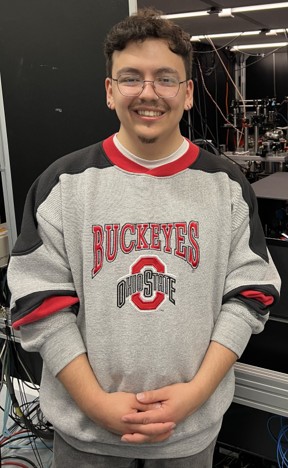
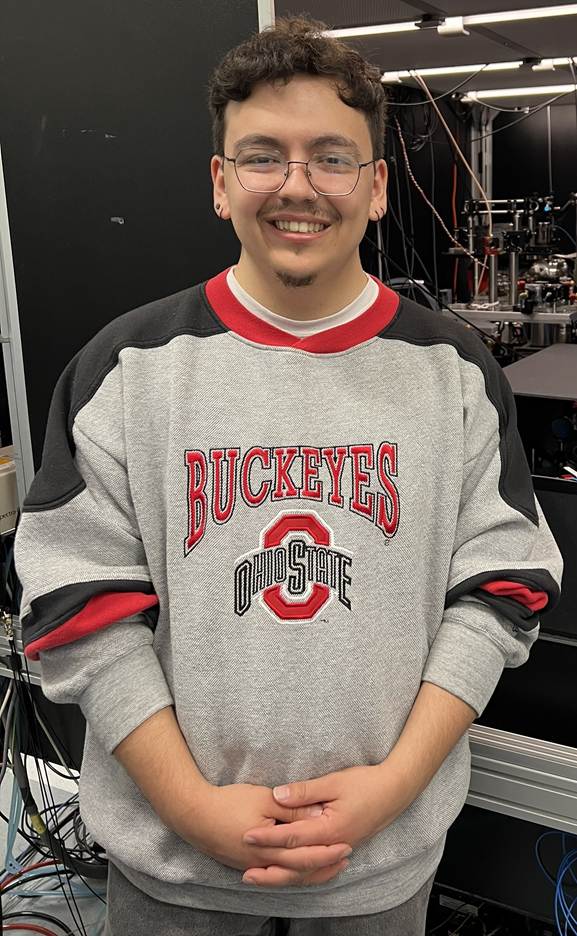
Caption: Julian Sewell.
For decades, quantum computing has largely existed in the realm of theory and laboratory research. Today, that is beginning to change.
As quantum technologies move closer to practical applications, researchers are confronting a new challenge: how to connect individual quantum computers into secure, high-performance networks capable of solving problems far beyond the reach of today's systems.
At The Ohio State University, an Ohio Federal Research Network (OFRN)-funded project is tackling one of the key barriers to making that future possible while simultaneously preparing the workforce that will help build it.
Through OFRN's Student Experiential Engagement (SEE) Program, graduate and undergraduate students are contributing directly to cutting-edge quantum research, gaining experience that extends well beyond the classroom and into Ohio's growing innovation ecosystem.
"Our goal is to develop photonic interfaces for quantum computers that will eventually enable a quantum internet," said Ohio State graduate researcher Julian Sewell. "We're working toward a future where quantum computers can communicate with one another across states or even countries."
The project, Photonic Interfaces for Atom-based Quantum Processors,seeks to develop fiber gap Fabry-Perot cavities (FFPCs) — miniature optical devices that efficiently couple individual photons emitted by atomic qubits directly into optical fibers. By creating robust light-matter interfaces compatible with existing telecommunications infrastructure, the technology could enable scalable quantum networks and distributed quantum computing.
Those networks have implications that extend well beyond faster computing.
"One of the biggest advantages of quantum communication is security," Sewell said. "Quantum information can be shared in a way that's secure against any currently known method of hacking. For national security and sensitive communications, that's incredibly important."
Unlike conventional computing systems, interconnected quantum processors could dramatically increase computational capability while providing fundamentally new approaches to secure communications.
But developing those technologies requires more than scientific breakthroughs. It requires a highly skilled workforce capable of designing, building and commercializing them.
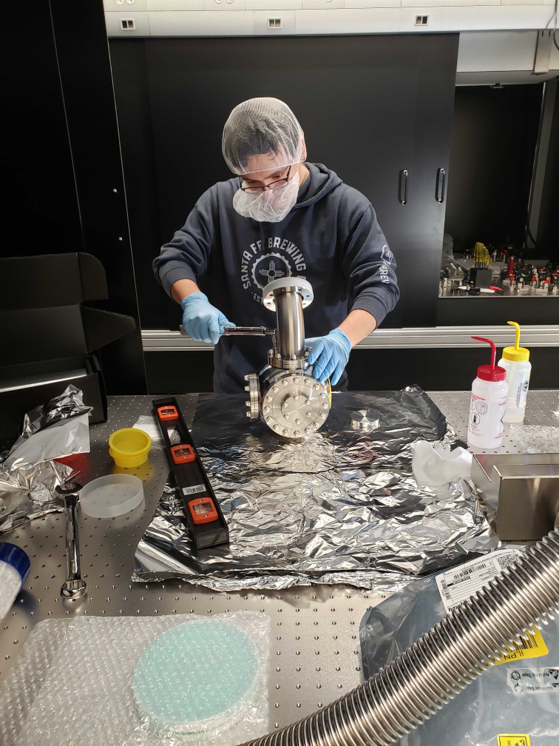
Caption: Sewell building one of the project experiments.
That workforce development is a central objective of OFRN's SEE Program, which was created to immerse Ohio students in real-world research environments. The program provides paid experiential learning opportunities that allow students to participate in technology development alongside university researchers, industry partners and government collaborators, helping move innovations from the laboratory toward commercialization and defense applications.
For Sewell, who recently completed his second year as a physics doctoral student at Ohio State, the experience has been as much about people as technology.
His own research began in particle physics during his undergraduate studies at Texas Tech University, where he developed an interest in experimental quantum science. After joining Ohio State, faculty presentations on emerging quantum research led him to the laboratory of principal investigator Kevin Singh, where he became involved in the OFRN-funded project.
Since then, his role has evolved beyond conducting research.
"I've spent a lot of time mentoring undergraduate students," Sewell said. "Watching students come into the lab with little or no research experience and then seeing them develop the skills to contribute independently has been one of the most rewarding parts of this project."
That mentorship reflects one of the SEE Program's defining strengths. Rather than limiting students to observing research, the program integrates them into multidisciplinary teams where they collaborate across academic, industry and government organizations while developing both technical expertise and professional skills.
For Sewell, that has meant learning advanced optical fiber technologies, collaborating with experienced researchers and touring the laboratories of industry partners to better understand how quantum technologies move beyond academia.
"Seeing what research and technology development looks like outside the university has been fascinating," he said. "It's given me a glimpse of what my future career could look like."
Those experiences have broadened his perspective on career opportunities throughout Ohio and beyond.
While he is still early in his doctoral studies, Sewell said the project has strengthened his interest in pursuing a career developing quantum technologies, whether in academia, industry or government research organizations such as the Air Force Research Laboratory or NASA Glenn Research Center.
The project is also helping position Ohio as a leader in one of the nation's fastest-growing technology sectors.
By establishing domestic manufacturing capabilities for photonic interfaces and strengthening partnerships among universities, industry and federal stakeholders, the research supports both national security priorities and the long-term growth of Ohio's quantum innovation ecosystem.
As quantum computing moves from scientific possibility toward practical reality, investments in workforce development are becoming just as critical as investments in technology itself.
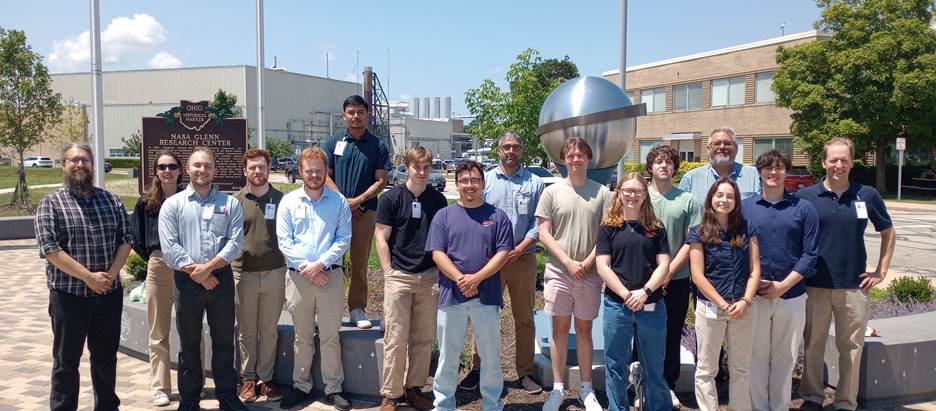
Caption: The Photonic Interfaces for Atom-based Quantum Processors team visited the NASA Glenn facility on July 8, 2026.
For students like Sewell, the opportunity to contribute to nationally significant research while learning alongside experts has already shaped the direction of their careers.
"It's opened my eyes to this technology and everything that goes into developing it," Sewell said. "Working with professors, industry professionals and researchers from different organizations has been an incredible learning experience. Everyone involved is excited about where this research is headed, and I think it's going to continue being a great experience moving forward."
###
About Ohio Federal Research Network (OFRN)
The Ohio Federal Research Network (OFRN) has the mission to stimulate Ohio’s innovation economy by building statewide university-industry research collaborations that meet the requirements of Ohio’s federal laboratories, resulting in the creation of technologies that drive job growth for the State of Ohio. The OFRN is a program managed by Parallax Advanced Research in collaboration with The Ohio State University and is funded by the Ohio Department of Higher Education.
About Parallax Advanced Research and the Ohio Aerospace Institute (OAI)
Parallax Advanced Research is a research institute that tackles global challenges through strategic partnerships with government, industry, and academia. It accelerates innovation, addresses critical global issues, and develops groundbreaking ideas with its partners. With offices in Ohio and Virginia, Parallax aims to deliver new solutions and speed them to market. In 2023, Parallax and the Ohio Aerospace Institute (OAI) formed a collaborative affiliation to drive innovation and technological advancements in Ohio and for the nation. The Ohio Aerospace Institute plays a pivotal role in advancing the aerospace industry in Ohio and the nation by fostering collaborations between universities, aerospace industries, and government organizations, and managing aerospace research, education, and workforce development projects.