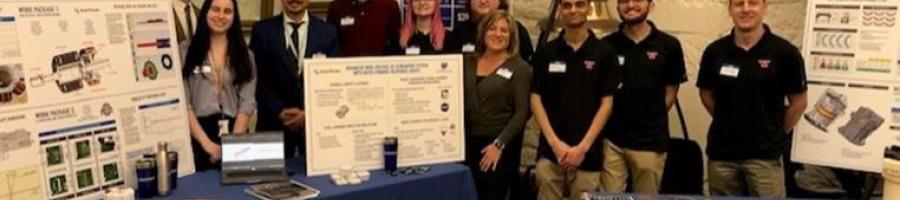

How OFRN-Funded R&D Is Advancing Next-Gen Power Systems – and Strengthening Ohio’s Aerospace Workforce Pipeline

Safran Electrical & Power’s Twinsburg, Ohio facility has long been a key contributor to the nation’s aerospace and defense industrial base. Today, that role is expanding. With support from the Ohio Federal Research Network (OFRN), Safran Electrical & Power is accelerating the development of next-generation electrical power systems for future military aircraft including technologies tied to the Army’s MV-75 Future Long Range Assault Aircraft (FLRAA) program. At the same time, the company is deepening its commitment to local workforce development, university partnerships, and small business engagement across the state.
Advancing Ohio’s Position in Next-Generation Aircraft Technology
At the Twinsburg site, Safran Electrical & Power designs and builds critical electrical systems for military and commercial platforms. The Twinsburg site supports these platforms by providing systems from main and starter generators to generator control units, transformer rectifier units, current transformer assemblies and power control units. Some of these capabilities directly support the Army’s next generation aircraft: the MV-75 FLRAA.
The newest OFRN-funded research award focuses on the development of an advanced high-voltage DC (HVDC) generator, a technology essential for powering the increasingly electrified systems on modern aircraft.
While HVDC generators share similarities with traditional AC systems, developing them presents distinct engineering challenges. OFRN funding allowed Safran Electrical & Power to systematically de-risk major components of a HVDC generator system.
“These advancements would have been difficult to pursue at the same speed or scale without OFRN support,” said Bob Devine, program manager, Safran Electrical and Power.
Why High-Voltage DC Power Matters for the Future of Aviation
Aircraft electrical loads are rapidly increasing as electrification replaces hydraulic systems and as advanced mission systems demand more power. For military platforms, the electrical load is growing exponentially due to advanced systems implementation.
This architecture is now standard across military aircraft. Safran’s new system is designed to maintain constant voltage while responding instantly to extreme, fast-changing loads; a capability essential to mission readiness and survivability.
Strengthening Ohio’s Economy Through Local Supplier Partnerships
Safran plays an integral role in Ohio’s aerospace supply chain. The company sources custom electronics, specialty castings, and precision components from dozens of Ohio-based small businesses, historically around 35 suppliers statewide. These partnerships contribute to a more resilient, diversified local economy and open doors for small manufacturers to enter or expand within the aerospace sector.
Ohio’s unique aviation heritage, from the Wright brothers to the modern Air Force Research Laboratory and NASA Glenn Research Center, continues to attract global aerospace leaders like Safran.
Major programs such as MV-75 FLRAA strengthen this ecosystem by bringing:
- High-paying engineering and manufacturing careers
- New investment from Tier 1 and Tier 2 suppliers
- Increased economic activity across housing, education, and services
- Greater national visibility for Ohio’s aerospace and defense capabilities
“We’re not just building equipment, we’re building careers for the 21st century,” said Devine..
Ohio’s density of research institutions is a major advantage. NASA Glenn and AFRL’s involvement as OFRN Federal Sponsors provides unmatched technical collaboration. Meanwhile, universities including The Ohio State University, University of Akron, University of Dayton, Youngstown State University, and University of Cincinnati supply a steady pipeline of engineering talent.
Safran Electrical & Power has hosted numerous engineering co-ops from these schools, many completing multiple rotations and later transitioning into full-time roles. Additionally, Safran Electrical & Power anticipates both direct and indirect job creation through its new projects. These include:
Direct roles:
- Electrical, mechanical, and systems engineers
- Test technicians
- Precision assembly and advanced manufacturing roles
- Quality assurance, supply chain, and logistics positions
Indirect benefits:
- Growth for local machine shops, testing facilities, and material suppliers
- New opportunities for Twinsburg businesses to join the aerospace supply chain
At the statewide level, success in next-generation power systems strengthens Ohio’s competitiveness for future DoD, NATO, and commercial projects while attracting new R&D and manufacturing investment.
Challenges and Opportunities in Growing the Ohio Talent Base
Ohio produces approximately 6,200 tech graduates each year, but the aerospace and defense sector faces:
- A high 13% attrition rate
- Workforce aging with ~25% of employees at or near retirement
- Competition from private tech companies offering higher salaries and more flexible work arrangements
Safran is responding by modernizing its approach to talent attraction and retention.
Key initiatives include:
- Hybrid work models and flexible scheduling to widen the talent pool
- Deepened university partnerships for internships and early recruitment
- Embedding R&D needs into intern assignments, allowing students to contribute immediately to meaningful work
- Expanding internship programs beyond engineering
Safran Electrical & Power is also prioritizing skill sets such as Model-Based Systems Engineering (MBSE), MATLAB/Simulink modeling, computational fluid dynamics (CFD), and finite element analysis (FEA).
Success Stories from Safran Electrical & Power’s Internship Pipeline
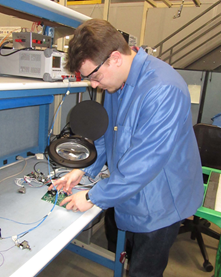
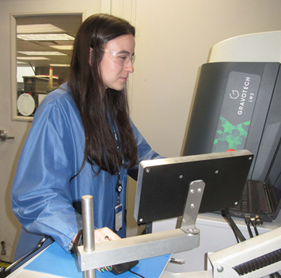
Two recent full-time hires, Alyssa Carnicella and Ian Ulle, represent the success of this model. Both completed multiple co-op rotations, taking on increasing levels of responsibility. Today, they support industrialization and design efforts for new product development at the Twinsburg facility.
Industrialization Engineer Ian Ulle examining a circuit card assembly.
|
Mechanical Engineer Alyssa Carnicella Working with the etching machine. |
Additionally, Safran Electrical & Power’s collaborations with Ohio State, University of Akron, and Youngstown State University have yielded substantial value.
One notable example: The Ohio State University helped prototype a non-linear, bi-directional controller that reduced transient response time by 60%. This breakthrough validated the technology and justified further development which is a direct reflection of the power of university–industry collaboration.
Looking Ahead: Building Ohio’s Next-Generation Aerospace Workforce
The OFRN-supported high-voltage DC generator project is more than a technological achievement, it is a catalyst for statewide economic development and workforce growth. By combining advanced R&D, strategic partnerships, and robust talent initiatives, Safran is helping secure Ohio’s position as a national leader in next-generation aviation technologies.
Safran’s continued success reinforces a shared message across Ohio’s aerospace ecosystem: The future of flight, and the workforce that will power it, is being built right here in Ohio.
###
This material is based upon work supported by the Army Contracting Command - Redstone Arsenal under Contract No. W58RGZ-23-C-0001. Any opinions, findings and conclusions or recommendations expressed in this material are those of the author(s) and do not necessarily reflect the views of the Army Contracting Command - Redstone Arsenal.
About Ohio Federal Research Network (OFRN)
The Ohio Federal Research Network (OFRN) has the mission to stimulate Ohio’s innovation economy by building statewide university-industry research collaborations that meet the requirements of Ohio’s federal laboratories, resulting in the creation of technologies that drive job growth for the State of Ohio. The OFRN is a program managed by Parallax Advanced Research in collaboration with The Ohio State University and is funded by the Ohio Department of Higher Education.
About Parallax Advanced Research and the Ohio Aerospace Institute (OAI)
Parallax Advanced Research is a research institute that tackles global challenges through strategic partnerships with government, industry, and academia. It accelerates innovation, addresses critical global issues, and develops groundbreaking ideas with its partners. With offices in Ohio and Virginia, Parallax aims to deliver new solutions and speed them to market. In 2023, Parallax and the Ohio Aerospace Institute (OAI) formed a collaborative affiliation to drive innovation and technological advancements in Ohio and for the nation. The Ohio Aerospace Institute plays a pivotal role in advancing the aerospace industry in Ohio and the nation by fostering collaborations between universities, aerospace industries, and government organizations, and managing aerospace research, education, and workforce development projects.